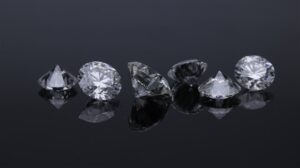
It literally rains diamonds on Neptune and Uranus. Methane molecules get crushed under extreme atmospheric pressure, forming diamonds that sink toward the planetary cores like glittering hail.
That’s just the beginning.
Diamonds aren’t just Earth’s hardest natural material—they’re cosmic wanderers, ancient time capsules, and industrial workhorses that power everything from Mars rovers to quantum computers. They predate dinosaurs by billions of years, yet form in conditions so extreme they’d vaporize most known materials.
This collection of 75 facts about diamonds spans cosmic phenomena, geological marvels, mining secrets, and scientific breakthroughs. Whether you’re a gem enthusiast, science lover, or just curious about these extraordinary crystals, you’ll discover facts that challenge everything you thought you knew about diamonds.
a) Cosmic & Planetary Diamonds
It Literally Rains Diamonds on Neptune and Uranus
Neptune and Uranus experience diamond precipitation. Atmospheric methane molecules get crushed under extreme pressure, converting into solid diamonds that sink through the planet’s interior like crystalline hail. Scientists estimate thousands of tons of diamonds exist in these planetary atmospheres at any given moment.
The Largest Diamond in the Universe Weighs 10 Billion Trillion Trillion Carats
Meet Lucy—a white dwarf star located 50 light-years from Earth. This cosmic diamond weighs approximately 10 billion trillion trillion carats. To put that in perspective, if you gathered every diamond ever mined on Earth, Lucy would still be incomprehensibly larger.
Mercury Has an 11-Mile Thick Diamond Layer
Beneath Mercury’s surface, at the core-mantle boundary, lies an 11-mile thick layer of diamonds. These formed 4.5 billion years ago under extreme pressure as the planet cooled. Mercury literally has a diamond shell separating its core from its mantle.
Planet 55 Cancri e: The Diamond World
This exoplanet may be one-third pure diamond by mass. With surface temperatures exceeding 3,800°F—hot enough to melt iron—55 Cancri e represents a world where diamond exists in conditions unimaginable on Earth.
Jupiter and Saturn Have Liquid Diamond Oceans
Deep within Jupiter and Saturn, where temperatures exceed diamond’s melting point, the diamond rain doesn’t just sink—it melts. Scientists believe these gas giants have liquid diamond oceans near their cores, where extreme heat transforms solid diamonds into molten seas.
Your Candle Flame Makes 1.5 Million Diamond Nanoparticles Per Second
Every candle flame produces approximately 1.5 million diamond nanoparticles per second in its core. These microscopic diamonds form from carbon in the wax but burn away almost instantly into carbon dioxide. You’re creating and destroying diamonds every time you light a candle.
b) Ancient & Extraterrestrial Diamonds
Diamonds Are Older Than Dinosaurs (and Most Stars)
Most natural diamonds formed between 1 and 3.5 billion years ago. The oldest diamonds predate oxygen in Earth’s atmosphere—3.5 billion-year-old specimens existed before life began on our planet. They’re older than countless stars visible in today’s night sky.
The Youngest Diamonds Are Still 900 Million Years Old
There are no “young” diamonds. Even the youngest natural diamonds are 900 million years old—incomprehensibly ancient by human standards. When you hold a diamond, you’re touching something that predates complex life on Earth.
Some Diamonds Came From Interstellar Space
Carbonado diamonds—mysterious black diamonds found only in Brazil and Africa—likely arrived via asteroid impact approximately 3 billion years ago. Their unique polycrystalline structure and geographic distribution suggest an extraterrestrial origin from another star system.
Meteorites Contain Nanodiamonds Older Than Our Solar System
Some meteorites contain 2.5-nanometer diamond crystals that formed in other star systems before our Sun existed. These presolar nanodiamonds are tangible evidence of stellar processes from distant cosmic neighborhoods, preserved within space rocks that eventually landed on Earth.
c) How Diamonds Form on Earth
Diamonds Form 100 Miles Beneath Earth’s Surface
Natural diamonds crystallize in Earth’s upper mantle, approximately 100 miles below the surface. Formation requires specific conditions: 725,000 pounds per square inch of pressure and temperatures around 2,200°F. Nothing less extreme will do.
Kimberlite Eruptions: Nature’s “Mentos in Soda”
Kimberlite volcanic eruptions blast diamonds to the surface in minutes through explosive, gas-charged reactions. Picture Mentos dropped into soda—that’s essentially what happens when volatile-rich magma carrying diamonds races upward at incredible speeds. This rapid ascent is crucial; slower journeys would give diamonds time to convert back into graphite.
Formation Can Take Billions of Years—Or Just Hours
Diamond formation timescales vary wildly. Most natural diamonds grew over billions of years through slow carbon crystallization. However, the process can stop and resume repeatedly over eons. Conversely, impact diamonds form in milliseconds during asteroid collisions.
Impact Diamonds Form in Milliseconds
When asteroids slam into Earth at speeds exceeding 26,000 miles per hour, the impact instantly converts graphite into diamonds. Russia’s Popigai Crater contains 72,000 tons of diamonds created in milliseconds when a meteorite struck 35 million years ago.
Medieval Nördlingen, Germany was unknowingly built from diamond-laced suevite rock from the Ries crater impact. The entire town sits on impact diamonds that residents didn’t discover for centuries.
Diamonds Don’t Come From Coal (The Biggest Myth)
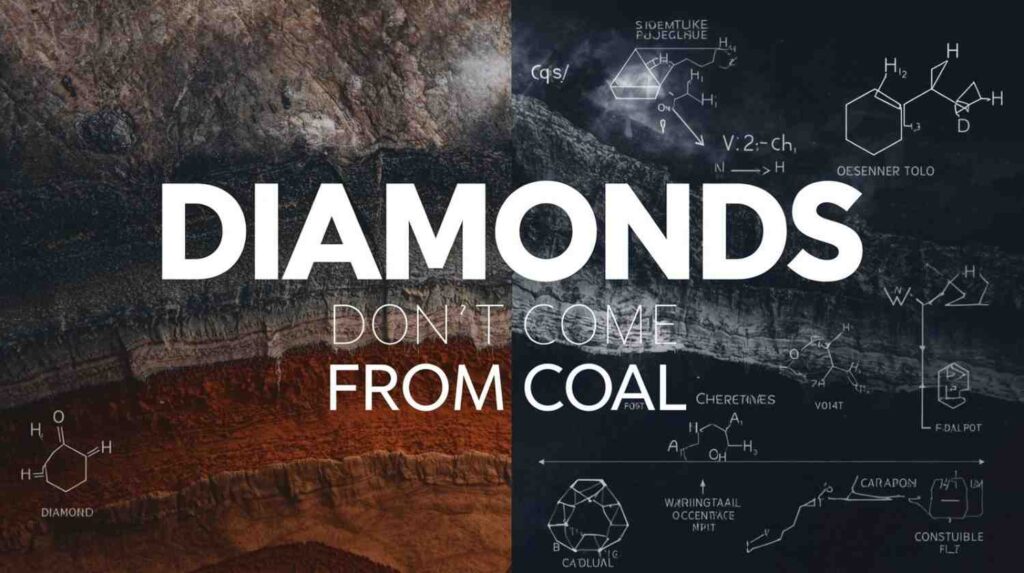
This is geology’s most persistent myth. Diamonds and coal have virtually nothing to do with each other. Coal forms from compressed plant material near Earth’s surface. Diamonds crystallize 100 miles deep in the mantle from carbon that never saw plants, photosynthesis, or sunlight. They form in completely different environments under incompatible conditions.
d) Scientific Surprises & Extraordinary Chemistry
Diamonds Are 58 Times Harder Than Anything Else in Nature
Diamonds score a perfect 10 on the Mohs hardness scale—58 times harder than the next hardest natural material. However, hardness doesn’t equal toughness. Diamonds have cleavage planes where they’re vulnerable to sharp impacts. One diamond can scratch another diamond.
Sound Travels Through Diamond 3X Faster Than Air
Sound velocity through diamond reaches 12,000 meters per second—over three times faster than through air. This makes diamond one of nature’s best sound conductors, a property that contributes to its unique acoustic signature.
Diamonds Have the Highest Thermal Conductivity of Any Material
Diamond conducts heat better than any metal, including copper. This is why jewelers use the “breath test”—breathe on a diamond and the fog disappears instantly because diamond disperses heat so efficiently. This property makes diamonds invaluable for cooling electronics.
Diamonds Can Burn Completely Into Carbon Dioxide
Despite their reputation for permanence, diamonds combust at 1,290-1,650°F. At this temperature, they burn completely into carbon dioxide gas, vanishing into thin air and leaving no trace. Diamonds are thermodynamically unstable at Earth’s surface—they just take millions of years to spontaneously convert to graphite.
Some Diamonds Conduct Electricity (Boron-Doped)
Pure diamonds are electrical insulators, but boron-doped diamonds defy expectations—they conduct electricity and can even become superconductors. These diamonds also exhibit plasmon waves, allowing electric fields to be controlled at the nanoscale while remaining optically clear.
Diamonds Contain “Almost Impossible” Chemistry
South African diamonds trap both oxygen-rich and oxygen-poor minerals that shouldn’t coexist under the same formation conditions. Some diamonds have nickel atoms replacing carbon in their crystal lattice—a mystery since nickel atoms are too heavy to normally fit the diamond structure.
A new mineral called davemaoite was discovered trapped inside a deep-Earth diamond. This mineral only exists under extreme mantle pressure and would never survive the journey to Earth’s surface without its diamond prison.
Diamonds Trap Ice-VII From 500 Miles Deep
Some diamonds contain Ice-VII—a high-pressure form of ice that only exists under extreme conditions. These inclusions prove that water exists in Earth’s deep mantle, approximately 500 miles down. One “worthless-looking” diamond proved Earth’s mantle contains an ocean’s worth of water through tiny ringwoodite inclusions from 320 miles deep.
Diamonds Glow Under X-Rays
Expose diamonds to X-ray radiation and they emit visible light—a property called radioluminescence. Mining operations use this phenomenon to separate diamonds from other minerals during processing.
PDF – Interesting Facts About Diamonds
e) Diamond Mining Around the World
Jwaneng, Botswana: The “Prince of Mines”
Jwaneng is the world’s richest diamond mine, producing 13.3 million carats annually. Its name means “place of small stones” in Setswana—an ironic understatement for a mine that generates billions in revenue.
Orapa: The World’s Largest Open-Pit Diamond Mine
Botswana’s Orapa mine is the world’s largest diamond mine by area. So nationally significant is this operation that its first processing plant appears on the country’s 20 pula banknote.
Botswana’s Diamond Revolution
Diamond mining accounts for one-third of Botswana’s GDP. The 1967 discovery of diamonds transformed Botswana from one of Africa’s poorest nations to one of its wealthiest. This mineral wealth funded infrastructure, education, and healthcare that repositioned the country’s entire trajectory.
Kimberley’s “Big Hole”: The Largest Hand-Dug Excavation
Between 1871 and 1914, approximately 50,000 miners armed with picks and shovels excavated Kimberley’s “Big Hole” in South Africa. They moved 22 million tons of earth, yielding 2,722 kilograms of diamonds. The resulting pit measures 463 meters wide and originally reached 240 meters deep—now partially filled with striking turquoise water, leaving 175 meters visible.
Kimberley became South Africa’s second-largest town by 1873, with 40,000 people drawn by the diamond rush. In 1882, it became the first city in the Southern Hemisphere with electric street lights. Africa’s first stock exchange was built here in 1881 during the diamond boom that created the De Beers empire.
Crater of Diamonds State Park: America’s Only Public Diamond Mine
Arkansas’s Crater of Diamonds State Park is the only public diamond mine where finders are keepers. Over 70,000 diamonds have been discovered since 1906, including an 8.52-carat gem found in 2015. Anyone can pay admission, dig, and keep whatever they find.
To Mine One 1-Carat Diamond, You Need 250 Tonnes of Earth
Producing a single 1-carat diamond requires mining approximately 250 tonnes of earth. Scale that up: approximately 500,000 tons must be processed to yield one million pounds of natural diamonds. This staggering ratio underscores diamonds’ genuine geological rarity.
f) Cutting & Polishing: Where Diamonds Become Brilliant
Antwerp: The Diamond Capital Since the 15th Century
Antwerp has been the global diamond capital since the 1400s, handling 84% of the world’s rough diamonds today—over $56 billion in annual turnover. The Diamond Quarter occupies just one square mile adjacent to Central Station but contains 380 workshops serving 1,500 companies.
In 1456, Lodewyk van Berken invented the scaif polishing wheel in Antwerp, revolutionizing diamond cutting. This innovation cemented the city’s position as the world’s premier diamond center.
The Brilliant Cut Was Invented by a 19-Year-Old
Marcel Tolkowsky was 19 years old when he invented the brilliant cut in Antwerp in 1919. His 57-facet design, based on mathematical calculations, returns 99.8% of the light entering the diamond—the “ideal cut” that maximizes brilliance. Today, 75% of colorless diamonds use Tolkowsky’s brilliant cut.
Surat, India Cuts 90% of the World’s Diamonds
Surat processes 8 out of 10 diamonds sold globally. This Indian city has over 5,000 diamond factories ranging from small family operations to massive facilities with state-of-the-art laser technology.
India’s diamond industry started in Surat in 1901 when an entrepreneur brought diamond cutters from East Africa to train local workers. The industry exploded in 1940 when the Japanese invasion of Myanmar forced artisans to flee Rangoon and return to their Gujarat hometown, bringing their expertise with them.
Surat workers have developed unique expertise cutting Zimbabwe diamonds due to familiarity with their specific size and color characteristics.
Dubai: The New Rough Diamond Trading Hub

Dubai overtook Belgium as the world’s largest rough diamond trading hub, with $22.8 billion in rough diamonds traded through the UAE in 2021. The Dubai Multi Commodities Centre (DMCC) houses over 1,300 diamond companies in the iconic 68-floor Almas Tower, featuring dedicated diamond trading floors and vaults.
Dubai’s diamond trade grew from $300 million in 2002 to $26 billion by 2016, strategically positioned between African mines and Indian polishing centers. The DMCC operates the world’s largest diamond tender facility and the UAE was the first Arab country to join the Kimberley Process in 2003.
Diamonds Lose 50% of Their Weight During Cutting
A rough diamond sacrifices approximately half its mass during cutting and polishing to achieve maximum brilliance. This is why rough stones appear so different from finished gems—craftsmen remove enormous amounts of material to reveal the fire within.
g) Extreme Rarity & Value
All Polished Diamonds Ever Cut Would Fill One Double-Decker Bus
If you gathered every polished diamond ever cut throughout human history, they’d fill approximately one double-decker bus. This visualization underscores their extreme rarity despite marketing that makes them seem abundant.
Only 30 True Natural Red Diamonds Exist Worldwide
Natural red diamonds are exponentially rarer than any other colored diamond. Approximately 30 genuine red diamonds exist worldwide—making them the rarest diamond color by an enormous margin.
Less Than 1% of Diamonds Are “Flawless”
Only about 1% of all gem-quality diamonds achieve “Flawless” grade under 10x magnification—meaning zero inclusions or blemishes. Over 99% of diamonds contain natural imperfections, most invisible to the naked eye.
Only 0.4% of All Diamonds Are Fancy-Colored
According to GIA records analyzing tens of thousands of diamonds over 20 years, only 0.4% of all graded diamonds qualify as fancy-colored. The overwhelming majority are colorless, near-colorless, or lightly tinted.
Only 20-30% of Mined Diamonds Are Gem-Quality
The remaining 70-80% of mined diamonds become industrial-grade material. Mining operations must process enormous volumes of rock to find the small fraction suitable for jewelry.
The Argyle Mine Produced 90% of Pink Diamonds—Then Closed in 2020
Australia’s Argyle mine supplied 90% of the world’s pink diamonds before closing in 2020. This shutdown made existing pink diamonds significantly rarer and more valuable, as no other source can match Argyle’s production.
Diamond Resale Value: The Uncomfortable Truth

The secondary market value of diamonds typically ranges from 25-50% of retail price. Unlike gold, which maintains value relative to its weight, diamonds lose substantial value upon resale—a reality that shocks most buyers expecting an “investment.”
h) Famous & Record-Breaking Diamonds
The Cullinan: Largest Gem-Quality Diamond Ever (3,106 Carats)
Discovered in 1905, the Cullinan Diamond weighed 3,106 carats—over 1.37 pounds, making it the largest gem-quality rough diamond ever found. Cutters divided it into 105 separate diamonds, including the 530-carat Great Star of Africa, now part of Britain’s Crown Jewels.
Sewelô: Largest Rough Diamond Found in a Century (1,758 Carats)
Botswana discovered the 1,758-carat black diamond Sewelô in 2020—the largest rough diamond found in an entire century. This discovery demonstrates that major diamond finds still occur in established mining regions.
The Pink Star: Most Expensive Diamond Ever ($71.2 Million)
The 59.60-carat Pink Star sold for $71.2 million at auction in 2017, setting the record for the most expensive diamond ever sold. Its size, color saturation, and clarity make it a once-in-a-generation gemstone.
The Golden Jubilee: Largest Faceted Diamond (545.67 Carats)
This brown diamond from South Africa’s Premier Mine holds the record as the largest faceted diamond at 545.67 carats. Brown diamonds were historically considered undesirable, but the Golden Jubilee’s size makes it exceptional regardless of color.
The Hope Diamond: History’s Most Famous Curse
The Hope Diamond may be the recut French Blue diamond, stolen during the French Revolution in 1792. It was “lost” for decades before reappearing under mysterious circumstances. Its supposed curse and brilliant blue color have made it history’s most famous diamond.
The Uncle Sam: Largest US Diamond (40.23 Carats)
The Uncle Sam diamond, discovered at Arkansas’s Crater of Diamonds in 1924, weighed 40.23 carats—the largest diamond ever found in the United States.
The Half-Pink, Half-Colorless Diamond (37.41 Carats)
A 37.41-carat diamond displays a sharp boundary between pink and colorless halves. Gemologists believe this formed in two separate geological stages millions of years apart, with each half crystallizing under different conditions.
The Briolette of India: Oldest Known Cut Diamond
Dating to the 12th century, the Briolette of India is the oldest known cut diamond. Ironically, despite its name, it actually came from South Africa.
The Antwerp Diamond Heist: $100 Million Vanished
In 2003, thieves bypassed 10 security layers—including a lock with 100 million combinations—to steal over $100 million in diamonds from Antwerp’s diamond district. Most of the diamonds were never recovered, making it one of history’s most successful heists.
i) Diamond Colors & What Causes Them
Blue Diamonds Contain Boron (And Conduct Electricity)
Blue diamonds get their color from boron atoms that absorb red and yellow light, emitting only blue wavelengths. These Type IIb diamonds are extraordinarily rare. The boron impurities also allow blue diamonds to conduct electricity—unique among gemstones.
Pink Diamonds Form Through Structural Deformation
Pink diamonds acquire their color through crystal lattice deformation. The structure must be bent or compressed precisely—too little produces no color, too much turns them brown. This delicate balance makes pink diamonds exceptionally rare.
Yellow Diamonds Get Color From Nitrogen
Nitrogen atoms replacing carbon in the crystal structure during formation create yellow diamonds. Nitrogen is the most common impurity in natural diamonds, making yellow the most common fancy color.
Green Diamonds Are Radioactive Survivors
Green diamonds acquire their color from natural radiation exposure over millions of years. Uranium or thorium in surrounding rocks bombards the diamond with radiation, gradually altering its color. The diamonds themselves aren’t dangerous—they simply survived long-term radiation exposure.
“Champagne” and “Cognac” Diamonds: Marketing Magic
“Champagne” and “cognac” diamonds are simply brown diamonds rebranded through clever marketing in the 1980s. This transformation turned historically “undesirable” brown diamonds into luxury items commanding premium prices.
Black Diamonds (Carbonado) May Be From Space
Black diamonds have a fundamentally different structure than other diamonds—they’re polycrystalline aggregates rather than single crystals. Found only in Brazil and Africa, their unique characteristics and limited distribution suggest possible extraterrestrial origins.
Truly Colorless Diamonds Are Rare
Most natural diamonds are brown, yellow, or tinted to some degree. Truly colorless diamonds—those grading D, E, or F on the color scale—are genuinely rare, making them more valuable than their slightly tinted counterparts.
UV Light Can Temporarily Change Diamond Color
About 25-35% of diamonds exhibit fluorescence—they glow under UV light, typically bright blue. Some diamonds exposed to UV radiation will temporarily change color for minutes or hours before reverting. This fluorescence can affect value positively or negatively depending on intensity and body color.
j) Historical & Cultural Diamond Facts About Diamonds
The First Diamond Engagement Ring (1477)
Archduke Maximilian of Austria gave the first recorded diamond engagement ring to Mary of Burgundy in 1477. The M-shaped design set with thin, flat diamonds initiated a tradition that would eventually sweep the world.
Ancient Greeks Thought Diamonds Were Tears of Gods
Ancient Greeks and Romans believed diamonds were tears cried by gods or fragments of fallen stars. They attributed supernatural powers to these mysterious stones, considering them capable of warding off evil and granting invincibility.
Medieval Europeans Believed Diamonds Could Cure Plague
During medieval times, Europeans believed powdered diamond could cure plague and other diseases. Pope Clement VII died after consuming powdered diamond as medicine—a lethal “cure” that claimed numerous lives.
In 20th Century France, Only the King Could Wear Diamonds
During certain periods in French history, diamonds were so rare that only the king could legally wear them. Commoners caught possessing diamonds faced severe legal consequences.
“Carat” Comes From Carob Tree Seeds
Ancient Greeks used carob tree seeds as standard weights for precious stones because the seeds were remarkably uniform in weight. The word “carat” derives from this practice. In 1907, the metric carat was standardized internationally at exactly 200 milligrams, ending centuries of weight confusion.
India Used Diamonds to Engrave Gemstones by 300 BCE
By 300 BCE, Indians were using diamonds to engrave other gemstones—one of humanity’s earliest industrial applications of the mineral. This predates European diamond use by over a millennium.
De Beers Created the Engagement Ring Tradition
De Beers’ “A Diamond is Forever” campaign launched in 1947 fundamentally changed global marriage culture. Before this marketing campaign, diamond engagement rings weren’t standard practice. This single advertising effort convinced generations that diamonds were essential to marriage proposals.
The “three months’ salary” rule was also De Beers marketing—not tradition. It’s advertising that convinced people this was the “proper” amount to spend on an engagement ring.
Ancient Cultures Wore Diamonds as Protection
Many ancient cultures believed diamonds held mystical powers that guarded against harm. Warriors wore diamonds into battle, believing the stones would protect them from injury and death.
k) Industrial & Modern Applications
Over 90% of Mined Diamonds Go to Industry, Not Jewelry
Engagement rings and fine jewelry represent the minority use for diamonds. Over 90% of all diamonds mined globally are destined for industrial applications, not adornment.
Oil Drilling Uses More Diamonds Than All Jewelry Combined
The oil industry is the diamond industry’s biggest customer. A single offshore drilling rig can consume millions of carats of diamond-embedded drill bits. Oil extraction uses more industrial diamonds than all jewelry manufacturing combined.
Your Smartphone Screen Was Cut by Diamond Wire Saws
Ultra-thin diamond-coated wires slice through sapphire and glass at microscopic tolerances to produce millions of smartphone displays. Without diamond cutting technology, modern touchscreen manufacturing would be impossible at current scales.
Diamond Drill Bits on Mars Rovers
NASA uses diamond-embedded drill bits on Mars rovers to grind through Martian rocks for sample collection. These bits withstand conditions that would destroy any other material, enabling interplanetary geology.
Diamond Heat Sinks Cool Nuclear Reactors
Synthetic diamonds absorb and dissipate heat so effectively that they’re used as heat sinks in nuclear power plants. In environments where failure isn’t an option, diamond’s unmatched thermal conductivity makes it irreplaceable.
The World’s Most Powerful Lasers Use Diamond Windows
Facilities like the National Ignition Facility use diamond windows in fusion experiments. Diamond can withstand the intense energy of these experiments without melting or shattering—properties no other transparent material can match.
Diamond Electrodes Purify Wastewater
Boron-doped diamond electrodes generate hydroxyl radicals that break down pharmaceuticals, pesticides, and “forever chemicals” that conventional wastewater treatment can’t eliminate. These electrodes literally destroy pollutants at the molecular level.
Diamond Radiation Detectors in Nuclear Facilities
Diamonds can detect individual subatomic particles and survive radiation levels millions of times higher than silicon sensors. This makes them ideal for monitoring nuclear reactors and particle accelerators where other detectors would quickly fail.
Diamond-Tipped Surgical Scalpels Last 1,000 Times Longer
Diamond scalpels used in eye surgery can cut 1,000 times longer than steel blades. They slice through tissue at the cellular level with unmatched precision, enabling surgeries impossible with traditional instruments.
Diamond Speakers Produce Zero-Distortion Audio
Because diamond tweeters are extraordinarily rigid yet light, they reproduce sound frequencies with accuracy impossible for metal or plastic speakers. Synthetic diamond speakers deliver audio with virtually zero distortion.
Diamond-Coated Razor Blades Cut Kevlar and Carbon Fiber
Industrial cutting tools use polycrystalline diamond coatings to slice through materials like Kevlar and carbon fiber that would instantly dull regular steel. These blades handle materials that no other cutting edge can process efficiently.
Henry Ford Financed Diamond Research
Henry Ford financed research to produce industrial-grade diamonds for cutting tools in automobile manufacturing. His investment pioneered synthetic diamond applications that revolutionized industrial production.
Diamond Needles Lasted 10X Longer on Phonographs
Vintage phonographs using diamond needles could play 600-1,000 hours before replacement, compared to only 60-100 hours for sapphire needles. Diamond’s hardness made it the premium choice for serious record collectors.
NASA Used Diamond Windows to Analyze Venus
NASA used a diamond spacecraft window to analyze Venus’s atmosphere because only diamond possessed both the strength to withstand the planet’s crushing pressure and the optical clarity needed for spectroscopic analysis.
Diamonds Are Being Used in Quantum Computing
Diamond’s unique atomic structure makes it ideal for storing and processing quantum information at room temperature. Unlike other quantum computing materials requiring extreme cooling, diamond operates under normal conditions.
Diamond Anvil Cells Recreate Earth’s Core Pressure
Scientists use two diamonds to create pressures exceeding those at Earth’s core in diamond anvil cells. These devices enable research into planetary interiors, exotic materials, and high-pressure chemistry impossible to study otherwise.
Diamond Dust in the Atmosphere Affects Climate
Microscopic diamonds in Earth’s upper atmosphere can influence cloud formation and heat retention. While their impact is still being studied, these atmospheric diamonds play a role in global climate patterns.
l) Mind-Blowing Diamond Myths Debunked
MYTH: Diamonds Come From Coal
FALSE. Diamonds and coal have virtually nothing to do with each other geologically. Coal forms from compressed plant material near Earth’s surface. Diamonds crystallize 100 miles deep in the mantle from carbon that never saw plants or sunlight. They form under completely incompatible conditions in entirely different environments.
MYTH: Diamonds Are Indestructible
FALSE. Hardness doesn’t equal toughness. While diamonds are the hardest natural material, they have cleavage planes where they’re vulnerable to sharp impacts. Diamonds can chip, break, or shatter if struck at certain angles.
MYTH: Diamonds Sparkle Naturally
FALSE. Raw, uncut diamonds don’t sparkle. Their brilliance comes entirely from expert cutting and mathematical precision. Marcel Tolkowsky’s 1919 calculations determined the exact angles needed to return 99.8% of entering light. Craftsmanship creates the sparkle, not nature.
MYTH: All Diamonds Are Colorless
FALSE. Most natural diamonds are brown, yellow, or tinted. Truly colorless diamonds are genuinely rare—not the default. The perception of colorless as “normal” comes from jewelry marketing, not geological reality.
MYTH: Flawless Diamonds Are Common
FALSE. Over 99% of diamonds contain inclusions. Less than 1% achieve “Flawless” grade under 10x magnification. The vast majority of diamonds have internal characteristics—they’re just invisible without magnification.
FACT: Moissanite Is Actually More Brilliant Than Diamond
Moissanite has a higher refractive index than diamond, creating more sparkle and fire. Despite costing 90% less than diamond, moissanite is objectively more brilliant by optical measurements. It’s a diamond simulant, not a diamond, but outperforms diamond in certain visual properties.
FACT: Lab-Grown Diamonds Are Real Diamonds
Lab-grown diamonds share identical chemical composition, crystal structure, and optical properties with natural diamonds. Created using HPHT (High Pressure High Temperature) or CVD (Chemical Vapor Deposition) methods in 2-3 weeks, they’re real diamonds—just grown in laboratories instead of Earth’s mantle over billions of years.
FACT: You Can Turn Human Ashes Into Diamonds
Cremation diamonds are genuine diamonds made from the carbon in human or pet remains. The process takes 6-9 months and produces real diamonds that are chemically and structurally identical to natural diamonds, creating permanent memorials from loved ones.
FACT: Diamonds Can Survive Being Swallowed
Diamond’s chemical inertness means diamonds pass through the digestive system completely unchanged. This fact has been exploited by diamond thieves throughout history who swallow diamonds to smuggle them past security.
FACT: No Two Diamonds Are Truly Identical
Even diamonds cut from the same original crystal develop unique atomic structures, inclusions, and internal patterns during formation and cutting. Like fingerprints, every diamond is microscopically unique.
m) Frequently Asked Questions About Diamonds
Are diamonds really the hardest material on Earth?
Yes, among naturally occurring materials. Diamonds score 10 on the Mohs hardness scale and are 58 times harder than anything else in nature. However, scientists have created synthetic materials that surpass diamond’s hardness, so diamonds are no longer the hardest material period—just the hardest natural one.
How old are most natural diamonds?
Most natural diamonds are between 1 and 3.5 billion years old. The oldest diamonds are 3.5 billion years old, formed before oxygen existed in Earth’s atmosphere. Even the youngest natural diamonds are still 900 million years old—incomprehensibly ancient by human standards.
Do diamonds really come from coal?
No, this is geology’s most persistent myth. Diamonds and coal form under completely different conditions in entirely separate environments. Coal forms near Earth’s surface from compressed plant material. Diamonds crystallize 100 miles deep in the mantle where plant material never existed. They have virtually nothing to do with each other.
Can diamonds burn or be destroyed?
Yes. Diamonds burn at temperatures between 1,290-1,650°F, converting completely to carbon dioxide gas. They can also chip or break despite their hardness due to cleavage planes. While diamonds are extremely durable, they’re not indestructible.
Why are some diamonds colored?
Different impurities and structural variations create diamond colors:
- Blue: Boron atoms absorb red and yellow light
- Yellow: Nitrogen atoms replacing carbon
- Pink: Structural deformation of crystal lattice
- Green: Natural radiation exposure over millions of years
- Black: Polycrystalline structure with numerous inclusions
How much does it cost to mine a 1-carat diamond?
Mining one 1-carat diamond requires processing approximately 250 tonnes of earth. Only 20-30% of mined diamonds are gem-quality—the remaining 70-80% become industrial grade. This enormous material-to-product ratio explains diamonds’ genuine geological rarity.
What’s the largest diamond ever found?
The Cullinan Diamond discovered in 1905 weighed 3,106 carats (over 1.37 pounds)—the largest gem-quality rough diamond ever found. It was cut into 105 separate diamonds, including the 530-carat Great Star of Africa, now part of Britain’s Crown Jewels.
Are lab-grown diamonds real diamonds?
Yes, chemically identical. Lab-grown diamonds have the same physical, chemical, and optical properties as natural diamonds. The only difference is origin—laboratories can grow real diamonds in 2-3 weeks using HPHT or CVD methods, versus billions of years in Earth’s mantle.
Which planet has diamond rain?
Neptune and Uranus experience diamond precipitation. Atmospheric pressure crushes methane molecules into solid diamonds that sink toward the planetary cores. Jupiter and Saturn likely have liquid diamond oceans near their cores where extreme heat melts the diamond rain into molten seas.
Where are most diamonds mined today?
Major diamond mining locations include:
- Botswana: Jwaneng (“Prince of Mines”) and Orapa mines
- Russia: Popigai crater
- South Africa : Kimberly
- Australia : (closed) Argyle mine
- Arkansas : (Crater of Diamonds public mine).
Why do diamonds sparkle?
Expert cutting returns light. “Ideal cut” returns 99.8% of light. Brilliance comes from craftsmanship, not natural property. Trivia : Brilliant cut was invented 1919.
What percentage of diamonds are used for jewelry?
Less than 10%. Over 90% of mined diamonds are destined for industrial use (drilling, cutting, electronics, manufacturing).
References and Further Reading
| Topic | Source | Link |
|---|---|---|
| Diamond Formation & Geology | Shirey, S.B., et al. (2013). “Recent Advances in Understanding the Geology of Diamonds.” Gems & Gemology, Gemological Institute of America | GIA Research |
| Diamond Formation Process | Natural Diamonds. “How Are Diamonds Formed? 10 Fascinating Scientific Facts” | Natural Diamonds |
| Coal Myth Debunking | Geology.com. “How Do Diamonds Form? They Don’t Form From Coal!” | Geology.com |
| Diamond Age & Inclusions | Smith, E.M., et al. (2024). “The Extraordinary Backstory of Natural Diamonds: A Diamond Is (and Has Been) Forever.” Gems & Gemology, GIA | GIA Fall 2024 |
| Diamond Properties Overview | Wikipedia Contributors. “Diamond” and “Material Properties of Diamond” | Wikipedia – Diamond |
| Thermal Conductivity | Berman, R., Simon, F.E., & Ziman, J.M. (1953). “The Thermal Conductivity of Diamond at Low Temperatures.” Proceedings of the Royal Society A, 220(1141), 171-183 | Royal Society |
| Diamond Heat Conductivity | Diamond Materials. “Thermal Properties of CVD Diamond” (2000 W/mK thermal conductivity research) | Diamond Materials |
| Diamond in Electronics | Malakoutian, M. (2025). “Diamond Thermal Conductivity: A New Era in Chip Cooling.” IEEE Spectrum | IEEE Spectrum |
| Diamond Thermal Composites | Kopeliovich, D. (2017). “Thermal Conductivity of Diamond Composites.” PMC – National Center for Biotechnology Information | PMC Article |
| Kimberlite Pipes & Transport | Geology In. “How Are Diamonds Formed” (150-200km depth formation) | Geology In |
| Global Diamond Deposits | Stachel, T., & Harris, J.W. (2022). “A Review of the Geology of Global Diamond Mines and Deposits.” Reviews in Mineralogy and Geochemistry, Vol. 88 | GeoScienceWorld |
| Lab-Grown Diamonds: HPHT | Gemological Institute of America. “HPHT and CVD Diamond Growth Processes” | GIA Diamond Growth |
| Lab-Grown Diamonds: CVD | Brilliant Earth. “How Are Lab Grown Diamonds Made? CVD & HPHT Diamond Processes” | Brilliant Earth |
| Synthetic Diamond Methods | Wikipedia Contributors. “Synthetic Diamond” | Wikipedia – Synthetic |
| CVD vs HPHT Comparison | Ritani. “CVD vs. HPHT Lab Grown Diamonds: What’s the Difference?” | Ritani Education |
| Synthetic Diamond Identification | GIA Research. “Synthetic Diamonds: Improved Quality and Identification Challenges” | GIA News |
| Diamond Industrial Applications | AZoM Materials. “How Are Synthetic Diamonds Made?” | AZoM |
| Diamond Heat Spreaders | Coherent. “The Cold Hard Facts about Diamond Heat Spreaders” | Coherent Blog |
| Diamond Formation Science | DiamondRensu. “How Are Diamonds Formed: The Science Behind the Sparkle” | DiamondRensu |
| Diamond Properties & Occurrence | Geology Science. “Diamond | Properties, Formation, Occurrence, Deposits” | Geology Science |
Additional Academic Resources
- Springer Nature: “Thermal Conductivity of Diamond” – Comprehensive research on diamond’s exceptional thermal properties and applications in electronics
- Taylor & Hart: “Lab Grown Diamonds: HPHT vs. CVD Explained” – Detailed comparison of synthetic diamond production methods
- Faithful Platform: “Comparing CVD vs. HPHT: Which Lab-Grown Diamond Is Right for You?” – Consumer guide to lab-grown diamond choices
- CSMH Semiconductor: “How Does Diamond Conduct Thermal Energy?” – Industrial applications of diamond thermal conductivity
- Brilliyond: “Thermal Conductivity of Diamonds” – Scientific explanation of diamond’s heat transfer properties
- Heger Diamond: “Thermal Conductivity Research” – Technical specifications of diamond thermal properties
Note: This article synthesizes information from peer-reviewed scientific journals, gemological institutes, and reputable geological organizations. All external links were verified as of January 2026. For the most current research, readers are encouraged to consult the Gemological Institute of America (GIA), the International Gemological Institute (IGI), and academic journals in mineralogy and geochemistry.